

Increase cooling capacity from 1,100 kW of -10 degree Glycol to 1,800 kW of -10 Degree Glycol.
Sector
Food and Beverage
Services we offered
Design, Pipework, Structural Steel, Project Management, Electrical, Renewables.
Project Objectives
Reduce product drip loss.
Increase cooling capacity from 1,100kW of -10 degree Glycol to 1,800kW of -10 Degree Glycol. De-carbonise the site cooling process through the removal of Synthetic refrigerants.
Project Scope
Over the past year, Styne Group has successfully delivered a major refrigeration upgrade at a local meat processing facility, whilst keeping the site fully operational throughout.
As a business we worked closely with the client in order to schedule elements of the project which could have impacted their ability to produce or store processed product. This phasing of the required works alongside our desire to mitigate any possible impact for the client down time resulted in the hire of temporary cooling equipment allowing us to relocate existing plant and equipment.
Result? The factory did not miss a beat and no impact on production.
Scope:
- Pre-project layouts.
- The fabrication of structural steel for pipe and roof supports manufactured in accordance with BS EN 1090-2 and certified to BS EN 1090-1.
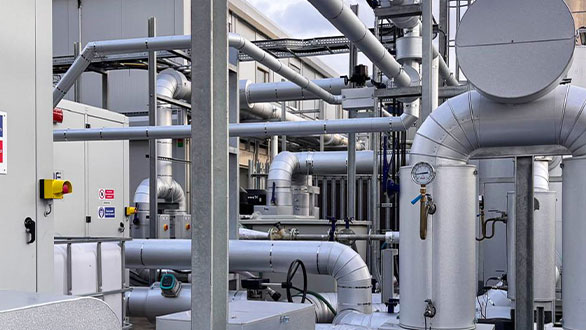
- Supply and install 5,000L Glycol buffer tank.
- Fabricate and install a DN200 -10°C Glycol delivery system.
- Fabricate and install a DN50 +35°C Warm Glycol Defrost system.
- Supply of a 1MW air cooled Glycol / Ammonia chiller.
- Supply of 13 Control panels and all field wiring.
- Installation of LV distribution.
- Mechanical and Electrical installation of 30 free issue Coolers.
- Supply of contract lift operations for the relocation of existing and installation of new refrigeration plant and equipment.
- Relocation of Solar PV panels.
The project saw us increase the site’s cooling capacity from 1100kW to 1800kW at -10°C, alongside the safe removal of an existing 300kW R404A synthetic refrigeration system.
Over the course of the project all aspects of Styne Group were utilised, from Design for layout work, the Workshop for the fabrication of EN1090 structural steel work, the site team for installation of steels and the fabrication of pipework and the Electrical division for the site mains overhaul, control panel installation, field wiring, even Styne Renewables for Solar panel relocation.
Much of the work had to be completed to tight deadlines and within a live factory environment; the client relied upon the extensive experience of both our project managers and project engineers.
Challenges faced |
Solutions |
|
|
Quality and Health and Safety Standards
Quality was supported through Styne Group’s ISO 9001 certified management system, NICEIC-approved electrical capability, and coordinated in-house delivery across fabrication, installation and commissioning. Structural steel fabrication was carried out to BS EN 1090 where applicable, supported by ISO 9606 qualified welders and ISO 15614 qualified welding procedures.
Pipework fabrication and installation were completed under controlled quality procedures, with pressure testing carried out as part of the verification and commissioning process. Planned lifting operations associated with plant relocation and equipment installation were delivered using lift plans and coordinated site controls to support safe execution within a live operational environment.
This approach allowed Styne Group to maintain control over quality, safety and delivery throughout the project.
Conclusion
This was a fast-moving project with an evolving scope, it was achievable because of the flexibility of both the new “plug and play” Zudek Airmatik 6 and the existing Zudek Airmatik 5 unit allowing site to be developed in ways that traditional plant room-based ammonia systems would have prohibited.
It was manageable thanks to the broad and extensive skill set that Styne Group boasts inhouse, the dedication of the whole team and the positive relationship between Styne Group and the Clients site management team.